

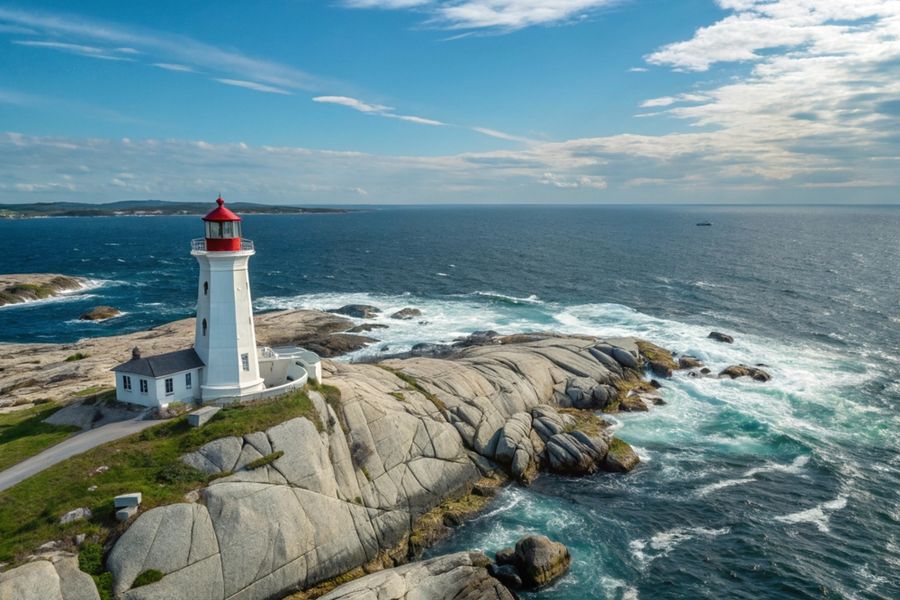
For centuries, lighthouses have stood along rugged coastlines, guiding ships past dangerous rocks, narrow channels, and unpredictable waters. Today, many have become destinations in their own right, attracting travelers with dramatic ocean views, fascinating maritime history, and striking architecture. Some occupy remote cliffs surrounded by wild landscapes, while others sit surprisingly close to major cities. Whether still operational or preserved as historic landmarks, famous lighthouses offer memorable stops on coastal vacations around the world.
Peggy's Point Lighthouse, Canada
Few Canadian lighthouses are as instantly recognizable as Peggy's Point Lighthouse at Peggy's Cove, Nova Scotia. The classic white tower topped with a red lantern stands against a landscape of enormous granite rocks and Atlantic Ocean views, creating one of Canada's most photographed coastal scenes.
The lighthouse itself dates to the early 20th century, although the area's maritime history stretches much further back. Visitors come not only to photograph the tower but also to experience Peggy's Cove, a small fishing community with colorful buildings, shops, restaurants, and plenty of maritime character.
The surrounding landscape is beautiful but demands caution. Waves can sweep across rocks unexpectedly, and visitors should pay close attention to posted warnings and avoid wet or dark rocks close to the water.
Peggy's Cove is within day-trip distance of Halifax, making it relatively easy to incorporate into a Nova Scotia vacation. Travelers with more time can continue exploring the province's coastal communities, beaches, seafood restaurants, and scenic driving routes.
Portland Head Light, United States
Situated in Cape Elizabeth, Maine, Portland Head Light looks exactly like many travelers imagine a traditional New England lighthouse should. Its white tower overlooks the rocky shoreline at the entrance to Portland Harbor and is surrounded by the scenic grounds of Fort Williams Park.
Commissioned during George Washington's presidency, Portland Head Light has a long history connected to navigation along Maine's famously rugged coastline. A museum located in the former keeper's quarters helps visitors learn more about the lighthouse and its past.
The surrounding park makes the destination particularly worthwhile. Walking paths provide different viewpoints of the lighthouse and coastline, while grassy areas offer space for picnics and leisurely afternoons by the ocean.
Its proximity to Portland is another advantage. Travelers can combine a lighthouse visit with the city's restaurants, breweries, shops, and famous Maine seafood. For anyone planning a broader New England road trip, Portland Head Light is an easy landmark to add to the itinerary.
Tower of Hercules, Spain
Not every famous lighthouse looks like the white-and-red towers commonly associated with coastal navigation. The Tower of Hercules in A Coruña, northwestern Spain, resembles an ancient stone monument, and for good reason: its origins stretch back to the Roman period.
The structure is considered the world's oldest known lighthouse that remains in operation. Its extraordinary history has also earned it recognition as a UNESCO World Heritage Site.
Visitors can experience both the lighthouse and its dramatic coastal surroundings. The tower stands on a peninsula overlooking the Atlantic, where walking paths weave through the landscape and provide impressive views of the ocean.
For travelers interested in history, the Tower of Hercules offers something particularly unusual. Rather than visiting a lighthouse constructed during the past few centuries, visitors can encounter a navigational landmark with roots reaching back roughly two millennia.
A Coruña itself adds another reason to stay longer. The Galician city offers beaches, seafood, waterfront areas, museums, and a distinctly different atmosphere from better-known Spanish destinations such as Barcelona or Madrid.
Cape Byron Lighthouse, Australia
Cape Byron Lighthouse occupies an impressive location at Cape Byron in New South Wales, near the popular coastal town of Byron Bay. Its position provides expansive views across the Pacific and makes it a favorite destination for walkers, photographers, and wildlife watchers.
The lighthouse was constructed around the beginning of the 20th century and remains an important landmark on Australia's eastern coastline. Its white exterior contrasts beautifully with the surrounding blue ocean and green headland.
One of the best ways to experience the area is by walking the Cape Byron track. The route takes visitors through coastal scenery and offers several viewpoints along the way. Depending on the season and conditions, travelers may also spot dolphins, sea turtles, seabirds, or migrating whales offshore.
Sunrise is an especially popular time to visit. Cape Byron is located at the easternmost point of mainland Australia, giving early risers an opportunity to watch the morning light arrive over the Pacific.
After visiting the lighthouse, travelers can spend the rest of the day enjoying Byron Bay's beaches, cafés, restaurants, shops, and relaxed coastal atmosphere.
Lindesnes Lighthouse, Norway
Travelers looking for a lighthouse surrounded by wild northern scenery should consider Lindesnes Lighthouse in southern Norway. Located on a rocky headland facing the sea, it has long been associated with ships navigating Norway's challenging coastline.
The site has an especially important place in Norwegian maritime history because Lindesnes was home to the country's first lighthouse station. The current lighthouse and surrounding facilities provide visitors with opportunities to learn about navigation, lighthouse keepers, maritime history, and life along the coast.
The landscape is a major part of the experience. Waves crashing against rocks and rapidly changing weather can create a dramatic setting, particularly outside the calmest summer days.
Unlike a quick roadside photo stop, Lindesnes can appeal to travelers who want to spend time understanding the relationship between lighthouses, shipping, weather, and coastal communities.
Its location also makes it an interesting addition to a southern Norway road trip, especially for travelers who prefer natural landscapes and maritime attractions.
Les Éclaireurs Lighthouse, Argentina
Near Ushuaia at the southern tip of Argentina, Les Éclaireurs Lighthouse stands on a small rocky island in the Beagle Channel. Its remote surroundings and red-and-white tower have made it one of Patagonia's most recognizable maritime sights.
Visitors generally see the lighthouse as part of a boat excursion from Ushuaia rather than walking directly up to it. The journey through the Beagle Channel is part of the attraction, offering views of rugged islands, mountains, seabirds, and marine wildlife.
The lighthouse is sometimes associated with the nickname "Lighthouse at the End of the World," although that name historically refers to a different lighthouse on Isla de los Estados. Even so, Les Éclaireurs' location near one of the world's southernmost cities certainly gives it an appropriately remote atmosphere.
A visit can easily become part of a larger Patagonian adventure. Ushuaia is a base for hiking, wildlife tours, visits to Tierra del Fuego National Park, and even cruises heading farther south toward Antarctica.
Hook Lighthouse, Ireland
Hook Lighthouse in County Wexford is remarkable for both its appearance and its age. Standing on the Hook Peninsula along Ireland's southeastern coast, the tower has guided ships for centuries and is considered one of the oldest operational lighthouses in the world.
Its thick stone walls give it an appearance closer to a medieval tower than many modern lighthouses. Guided experiences allow visitors to learn about the site's history and the generations of people who helped keep ships safe along the coastline.
The surrounding peninsula adds to its appeal. Coastal views, historic sites, small communities, and scenic roads make the lighthouse a worthwhile stop during a road trip through southeastern Ireland.
Weather can dramatically change the experience. On a calm, sunny day, the coast can appear peaceful and inviting. During rougher conditions, the crashing waves provide a vivid reminder of why lighthouses were so essential to sailors navigating dangerous waters.
Neist Point Lighthouse, Scotland
Located on the Isle of Skye, Neist Point Lighthouse occupies one of the most dramatic lighthouse settings in Scotland. The lighthouse sits near steep cliffs that extend into the Atlantic, surrounded by the rugged landscapes that make Skye such a popular destination.
For many visitors, the main attraction is the scenery rather than the lighthouse building itself. Walking in the area provides views of cliffs, ocean, surrounding hills, and the lighthouse perched below.
Sunset can be particularly spectacular when conditions cooperate. The exposed location, however, means visitors should be prepared for wind, rain, and rapidly changing weather.
Neist Point also appeals to wildlife enthusiasts. Whales, dolphins, seabirds, and other marine life may sometimes be spotted from the coastline, although sightings are never guaranteed.
Because Skye has so many natural attractions, the lighthouse fits easily into a longer trip that includes hiking, waterfalls, mountains, small villages, and scenic drives.
Coastal Landmarks Worth the Journey
Lighthouses have evolved from essential navigational structures into some of the world's most distinctive coastal landmarks. Canada's Peggy's Point Lighthouse delivers a classic Atlantic scene, Australia's Cape Byron Lighthouse overlooks the Pacific, and Norway's Lindesnes Lighthouse showcases the power of a rugged northern coastline. Historic landmarks in Spain and Ireland add centuries of maritime history, while remote locations in Patagonia and Scotland demonstrate just how dramatic a lighthouse setting can become.
Whether visited for photography, history, wildlife, hiking, or simply an unforgettable ocean view, a great lighthouse can turn an ordinary coastal drive into one of the most memorable parts of a vacation.